
Table of Contents
Introduction
A muscle massage gun is effective only when its power, amplitude, and usage match your tissue tolerance and recovery goals—not when you simply buy the strongest model.
Most people buy a muscle massage gun expecting instant recovery and pain relief. The problem? Many end up bruised, overstimulated, or disappointed. The solution isn’t avoiding massage guns—it’s using the right one, the right way, for the right body.
Clear answer upfront:
Yes, muscle massage guns work—but only as short-term recovery tools, not miracle fixes. When matched correctly, they reduce soreness and improve mobility. When misused, they delay healing.
Key Takeaways
Percussion helps recovery, not muscle growth.
Beginners should avoid high-amplitude devices.
Athletes benefit from consistency, not aggression.
Pain relief ≠ tissue healing.
Price often reflects durability and service, not results.
How Muscle Massage Guns Actually Work
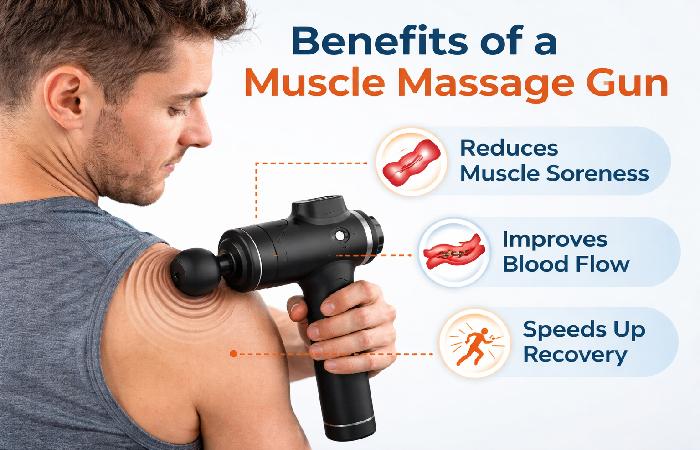
Neurological gating: reduces pain perception.
Temporary blood flow increase: helps soreness.
Muscle tone modulation: improves short-term mobility.
They do not:
Heal injuries.
Replace rehab or strength training.
Organizations like the American Council on Exercise and National Academy of Sports Medicine consistently frame them as adjunct tools, not treatments.
Benefits—And Where Claims Go Too Far
Realistic benefits
Faster perceived recovery
Reduced DOMS discomfort
Improved warm-up readiness
Overstated claims
“Breaks scar tissue”
“Detoxifies muscles”
“Permanent pain cure”
Massage guns help you feel better faster. They don’t rebuild tissue.
Risks, Misuse & Who Should Be Careful
- Acute inflammation
Nerve sensitivity
Chronic pain syndromes
High-power devices can overstimulate nerves, especially around the neck, spine, and joints.
How to Choose the Right Muscle Massage Gun
Beginner (Home / Desk Job)
Low amplitude
Quiet motor
Soft heads
Intermediate (Gym-Goers)
Medium amplitude
Multiple speed controls
Balanced weight
Professional / Athlete
High durability
Consistent torque
Service availability
Brands like TheraGun and Hyperice dominate clinics for reliability—not just power.
Specialist Reviews (Country-Wise Snapshot)
| Country | Specialist Preference | Reason |
|---|---|---|
| USA | TheraGun | Clinical reliability |
| UK | Hyperice | Balanced power & noise |
| India | Boldfit | Price accessibility |
| Germany | Beurer | Medical-grade trust |
| Australia | TimTam | Athlete-focused build |
Competitive Table: Brands × Countries × Pricing
| Brand | US | UK | India | Germany | Australia |
|---|---|---|---|---|---|
| TheraGun | $$$ | $$$ | $$$$ | $$$ | $$$ |
| Hyperice | $$$ | $$$ | $$$$ | $$$ | $$$ |
| TimTam | $$$ | $$ | $$$ | $$ | $$$ |
| Beurer | $$ | $$ | $$ | $$ | $$ |
| Boldfit | — | — | $ | — | — |
(Pricing is relative; reflects positioning, not exact cost.)
Yearly Price & Adoption Trend (Qualitative)
2019–2020: Athlete-only niche
2021–2022: Home recovery boom
2023–2025: Price stabilization, premium segmentation
Most innovation now focuses on ergonomics and noise, not raw power.
Final Verdict
Buy a muscle massage gun if:
You want faster recovery between workouts.
You understand it’s a support tool, not treatment.
Skip or delay if:
You expect it to “fix” injuries.
You’re sensitive to nerve stimulation.
FAQs
1. Does a muscle massage gun really work?
Yes, it reduces soreness and improves short-term mobility, but it doesn’t heal injuries.
2. Is a massage gun safe for daily use?
For most people, yes—if used lightly and not on sensitive areas.
3. Can beginners use high-power massage guns?
Not recommended. High amplitude can cause irritation or bruising.
4. How long should you use a massage gun on one muscle?
Usually 30–90 seconds per area is sufficient.
5. Are expensive massage guns better?
They’re usually more durable and quieter, not necessarily more effective.