

Table of Contents
Inroduction
If you’ve ever stood in front of a mirror holding three serums and wondered, “Do I really need all this?”—you’re not alone. Skincare has become noisy. Trends change weekly, product launches are endless, and advice on social media often contradicts itself.
The truth is simpler and far more reassuring: great skin doesn’t come from doing more—it comes from doing the right things consistently. A well-built skincare routine supports your skin’s biology, protects it from daily damage, and helps it repair itself over time.
This guide cuts through the hype and explains, in a very human and realistic way, how to build a skincare routine that fits real life—not influencer fantasy.
What a Skincare Routine Is Really Meant to Do
At its core, your skin has three basic needs:
Cleansing – removing dirt, oil, pollution, and makeup
Protecting – shielding skin from UV damage and environmental stress
Repairing – supporting renewal while you rest
Every effective skincare routine—whether it has three steps or ten—exists to serve these needs. When routines fail, it’s usually because they overwhelm the skin barrier or introduce too many active ingredients at once.
Dermatology research consistently shows that barrier health and sun protection matter more than expensive or complex products.
Step One: Know Your Skin (Not the Label, the Behavior)
Skin types aren’t fixed identities—they’re patterns of behavior.
If your face feels tight after washing → your barrier may be compromised
If you’re shiny by midday → oil production is high (often dehydration-driven)
If products sting → sensitivity is present, even if you’re not “sensitive skin”
Your routine should respond to how your skin behaves today, not how it behaved five years ago or how a product description categorizes you.
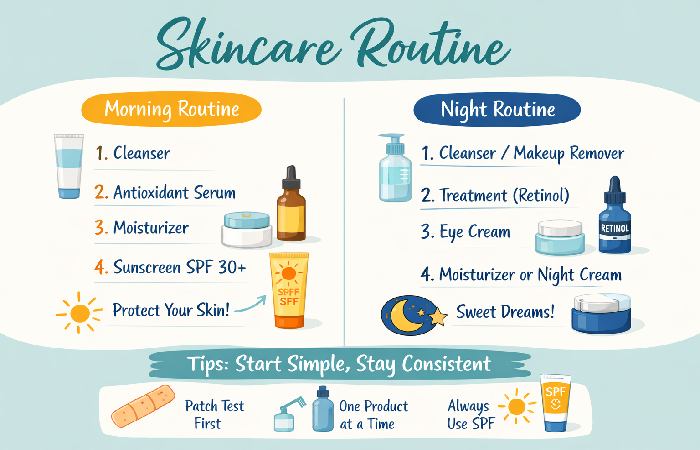
Morning Skincare Routine: Protect First, Perfect Second
Morning skincare isn’t about treating problems—it’s about defense.
1. Cleanser
Use a gentle cleanser to remove sweat and oil from the night. If your skin is very dry or sensitive, rinsing with water alone can be enough in the morning.
2. Antioxidant or Hydrating Serum (Optional)
Vitamin C, niacinamide, or hydrating serums help protect against pollution and oxidative stress. This step is helpful but not mandatory.
3. Moisturizer
Hydration keeps your skin barrier intact. Even oily skin needs moisture—skipping it often causes more oil production.
4. Sunscreen (Essential)
This is the most important step. Daily use of broad-spectrum sunscreen reduces premature aging, pigmentation, and long-term skin damage. If you do nothing else in the morning, use sunscreen.
A simple rule: if the sun is up, sunscreen is on.
Night Skincare Routine: Repair Without Overdoing It
Nighttime is when your skin naturally repairs itself. Your job is to support that process—not interrupt it.
1. Cleanse
If you wore sunscreen or makeup, cleansing at night is essential. Use a gentle cleanser; double cleansing is optional, not mandatory.
2. Treatment Products (Only If Needed)
This is where acne treatments, pigmentation serums, or exfoliating acids belong. Fewer is better—your skin can only process so much at once.
3. Retinol (Optional but Powerful)
Retinoids are among the most researched skincare ingredients for acne and aging. Start slowly—2–3 nights per week—and moisturize well.
4. Moisturizer or Night Cream
This seals in hydration and supports overnight repair. A good moisturizer often does more for your skin than another serum.
The Biggest Skincare Mistakes People Make
Let’s be honest—most skincare problems come from trying too hard.
Common mistakes include:
Using too many active ingredients at once
Exfoliating daily
Changing products every week
Skipping sunscreen because it “feels heavy”
Expecting instant results
Skin changes slowly. Most improvements take 6–12 weeks, not 6–12 days.
Do Expensive Products Work Better?
Not always.
Well-formulated skincare from brands like The Ordinary or Neutrogena often performs just as well as luxury options because results depend on:
Ingredient quality
Proper concentration
Consistent use
Luxury skincare can feel nicer, but results come from science, not price tags.
When You Should See a Dermatologist
Skincare routines are for maintenance—not medical treatment.
Consult a dermatologist if you have:
Persistent acne
Sudden pigmentation changes
Chronic irritation or redness
Skin conditions like eczema or rosacea
Prescription treatments often work faster and more effectively than cosmetic products.
kincare Brand Price & Availability Comparison: Top 5 Countries
| Brand / Country | United States (Retail Range) | United Kingdom (Retail Range) | India (Retail Range) | South Korea (Retail Range) | France (Retail Range) |
|---|---|---|---|---|---|
| The Ordinary | $6–$15 | £5–£15 | ₹400–₹1,200 | ₩6,000–₩15,000 | €6–€15 |
| La Roche-Posay | $12–$30 | £10–£25 | ₹1,800–₹3,500 | ₩10,000–₩28,000 | €10–€30 |
| Neutrogena | $10–$25 | £8–£20 | ₹600–₹1,500 | ₩8,000–₩20,000 | €8–€20 |
| COSRX | $12–$30 | £10–£25 | ₹1,000–₹2,500 | ₩8,000–₩20,000 | €10–€30 |
| Estée Lauder | $60–$180 | £45–£140 | ₹5,000–₹18,000 | ₩70,000–₩180,000 | €90–€150 |
A Realistic “Low-Stress” Skincare Routine (For Busy People)
If life is hectic, this is enough:
Morning
Cleanser
Moisturizer with SPF
Night
Cleanser
Moisturizer
That’s it. Everything else is optional.
Consistency beats complexity every single time.
Frequently Asked Questions
How long until I see results?
Hydration improves within days. Acne, pigmentation, and texture changes take weeks to months.
Is toner necessary?
No. It’s optional and depends on the formulation.
Can men follow the same routine?
Yes. Skin biology doesn’t change by gender.
Should I stop skincare if my skin breaks out?
Usually no—simplify instead of quitting completely.
Final Thoughts: Skincare That Fits Real Life
The best skincare routine is one you can stick to—on tired days, busy mornings, and long nights. Healthy skin doesn’t come from chasing trends or copying someone else’s shelf. It comes from understanding your skin, protecting it daily, and treating it gently over time.